| Wing Flaps
Wing flaps, installed on the wings of most modern airplanes, have two
important functions. First, they permit a slower landing speed and, therefore,
decrease the required landing distance. Second, because they permit a
comparatively steep angle of descent without an increase in speed, it is
possible, while making maximum utilization of the available landing area, to
safely clear obstacles when making a landing approach to a small field. They may
also be used to shorten the takeoff distance and provide a steeper climb path.
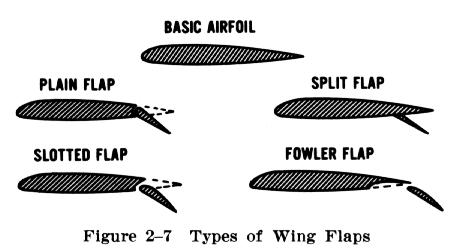
| Most wing flaps are hinged near the trailing edges of the
wings, inboard of the ailerons (Fig. 2-7). They are controllable by the
pilot either manually, electrically, or hydraulically. When they are in
the up (retracted) position, they fit flush with the wings and serve as
part of the wing's trailing edge. When in the down (extended) position,
the flaps pivot downward from the hinge points to various angles ranging
up to 40° - 50° from the wing. This in effect increases the wing camber
(curvature) and angle of attack, thereby providing greater lift and more
drag so that the airplane can descend or climb at a steeper angle or a
slower airspeed. |
|
 |
FAATest.com
- Aviation Library
Dauntless
Software hosts and maintains this library as a service to pilots
and aspiring pilots worldwide. Click
here for ways to show your appreciation for this service.
While much of this material comes from the FAA, parts of it are (c) Dauntless Software, all rights reserved. Webmasters: please
do not link directly to individual books in this library--rather,
please link to our main web page at www.dauntless-soft.com or
www.faatest.com. Thanks! |
|